

Europe Just Changed the Rules of Global Business
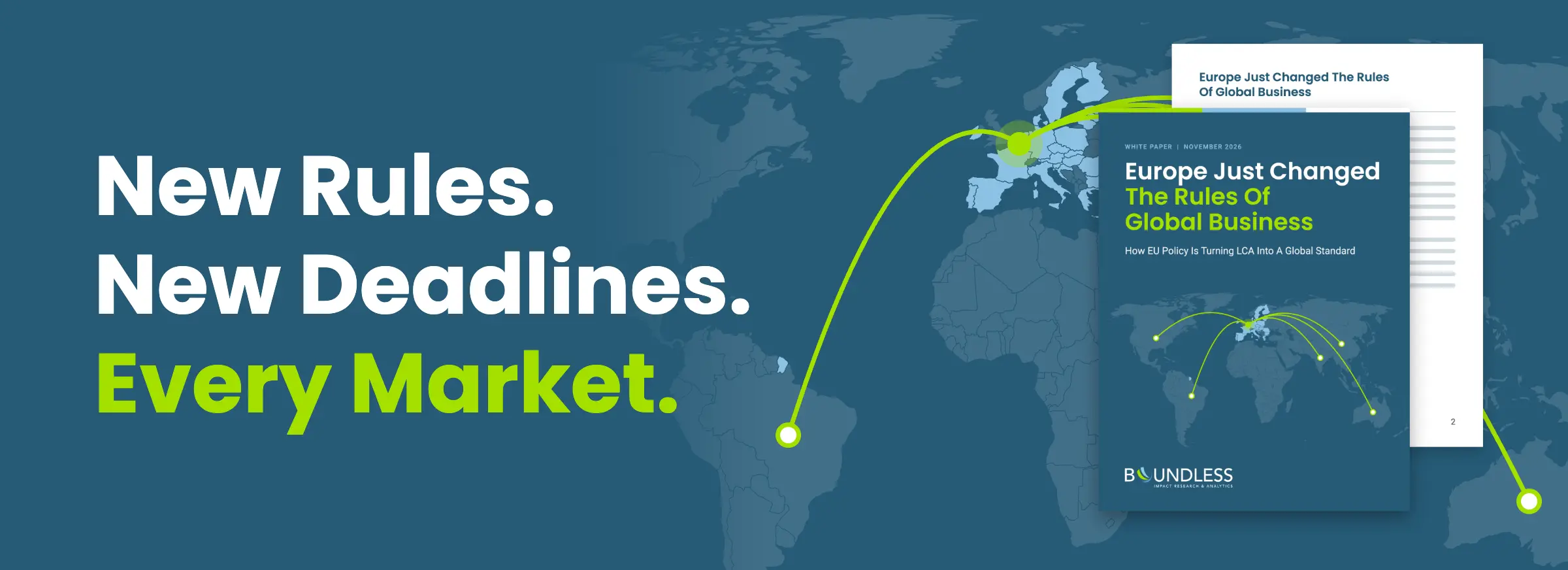
The European Union (EU) is changing what counts as proof of sustainability performance. Instead of company-wide reports, the EU now uses verified sustainability data on each product to decide which products reach its roughly 450 million shoppers. The requirement applies to companies selling physical products (except food and medicine) in the EU, wherever the company is based, and other countries are writing similar rules. Our new white paper, Europe Just Changed the Rules of Global Business, covers each new EU rule and what it means for companies outside the EU. Verified sustainability data is becoming the price of market entry. Life Cycle Assessment (LCA), which follows the international standard for LCA, ISO 14040/14044, is how companies produce verified sustainability data.
Demand Doesn’t Wait For Washington
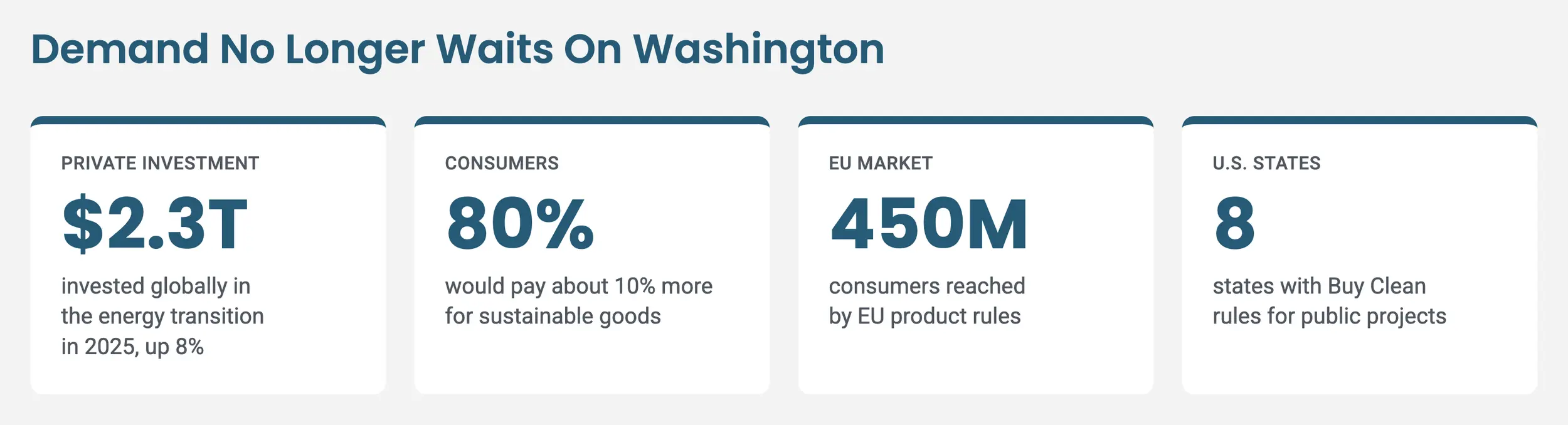
For U.S. companies, the pressure to prove product sustainability does not depend on Washington. Federal energy policy has swung back and forth for 50 years. In 2025, the One Big Beautiful Bill Act ended tax credits for new electric vehicles and cut credits for many new wind and solar projects. In 2026, the Environmental Protection Agency rescinded the finding behind most federal greenhouse gas rules.
However, global investment in the energy transition kept growing anyway, reaching a record $2.3 trillion in 2025, 8% more than in 2024. The figure below shows who else is asking for proof of product sustainability. Requests for product sustainability data now come from customers and foreign markets.
Built In Brussels, Required Everywhere
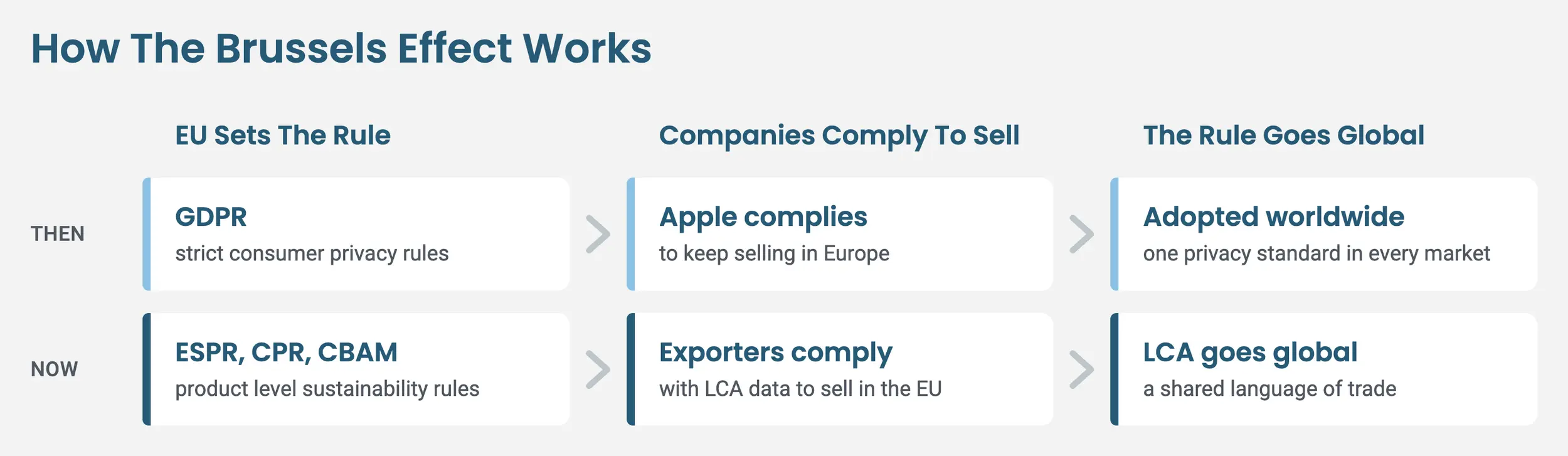
The biggest driver of requests for product data is a new set of EU product rules, which reach far beyond the EU. Most companies don’t want to make one version of a product for the EU and another for everyone else, so many companies follow the EU’s strictest rules in every market. Columbia Law School professor Anu Bradford calls the pattern the Brussels Effect. For example, Apple followed the EU’s privacy law to keep selling in the EU, then applied the same privacy rules worldwide.
EU sustainability rules now follow the Brussels Effect too, and the EU has changed what it asks companies to prove. In 2026, the EU dropped mandatory sustainability reporting for about 90% of companies. A newer law, the Ecodesign for Sustainable Products Regulation (ESPR), lets the EU set sustainability rules for almost every physical product sold in the EU, starting with products worth nearly €1 trillion in yearly sales. The figure below compares company reporting and product rules. The proof the EU wants has moved from company-wide reports to individual products.
Verified Data Is The Price Of Market Entry
Four EU rules now tie market access, border costs, or marketing claims to verified product data. The first covers construction products: every bag of cement sold in the EU comes with a Declaration of Performance, the form that earns the product its CE mark, the EU’s stamp that clears a product for sale. Under the revised Construction Products Regulation, the declaration must also state the cement’s global warming potential: the greenhouse gas emissions the cement causes over its life, calculated with an LCA. Once the regulation covers a product type, any product without a global warming potential figure loses its CE mark and can’t be sold in the EU.
The other three rules ask for verified data at the border, on the label, and in a passport:
- At the border: since January 2026, importers of cement, steel, aluminum, fertilizers, hydrogen, and electricity owe a carbon price on each product’s embedded emissions, the greenhouse gases released while making the product. This is the Carbon Border Adjustment Mechanism (CBAM).
- On the label: since September 27, 2026, generic claims such as “eco-friendly” are banned unless a company shows recognized excellent sustainability performance.
- In the passport: from February 2027, EV and large industrial batteries sold in the EU will need a Digital Product Passport, a QR-linked record of the data behind a product’s sustainability claims.
The Global Sustainability Crackdown Has Begun
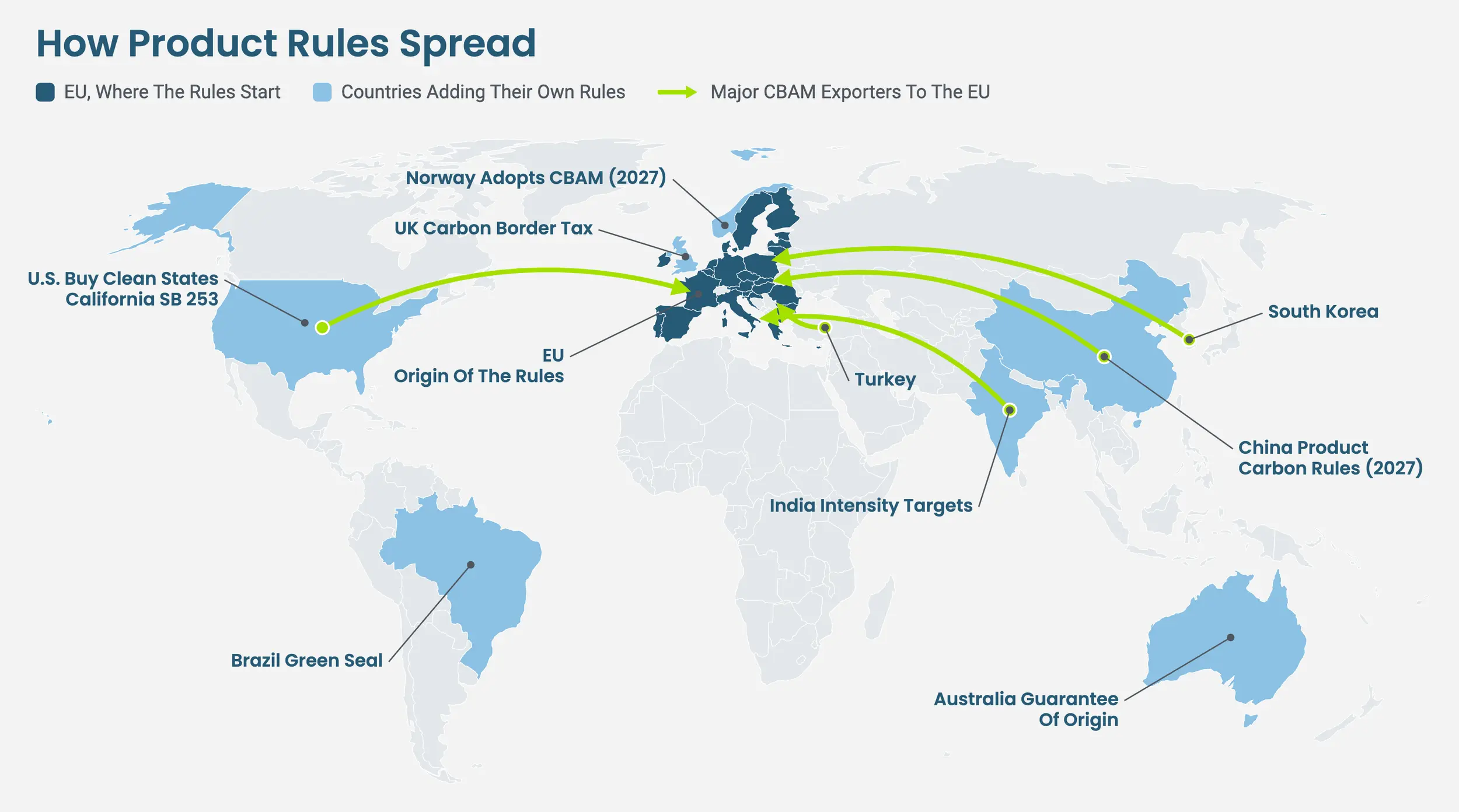
The EU went first, and other countries are adding their own product rules. On January 1, 2027, the United Kingdom will launch its own carbon border tax, and Norway will begin applying the EU’s CBAM. China plans carbon accounting rules for about 100 products by 2027. Japan made its emissions trading system mandatory in April 2026 and is writing product carbon footprint rules for steel. In the U.S., eight states use Environmental Product Declarations (EPDs), verified summaries of a product’s LCA results, to track or cap the carbon in public project materials, and California’s SB 253 will phase in supply chain emissions reporting starting in 2027.
What Your Customers Will Ask For
EU product rules reach companies outside the EU through their customers, in two main forms:
- An importer’s emissions form: an EU importer asks the producer for verified emissions data, so the importer pays CBAM on actual emissions instead of EU default values, which are set higher on purpose.
- A buyer’s questionnaire: in 2025, more than 270 corporate buyers used the disclosure nonprofit CDP to request sustainability data from about 45,000 suppliers.
Proof That Travels With Your Products
Our white paper, Europe Just Changed the Rules of Global Business, covers every rule mentioned in this blog in detail: when each rule takes effect, how much more importers pay on EU default values through 2028, and two Boundless case studies, a European chemical recycler and a U.S. fertilizer startup.
The EU now asks for proof about each product instead of a report about the whole company. That proof decides whether a product sells in the EU, what an importer pays at the border, and what a company can claim.
Boundless built LifeCycle IQ to give each product that proof and keep the proof current as products, suppliers, and rules change. Every LifeCycle IQ model follows ISO 14040 and 14044 and documents the source of each number, so the evidence is traceable when a regulator or buyer asks.
See It in Action with LifeCycle IQ
Our LifeCycle IQ platform combines product-level LCA and cost analysis, benchmarked against 450+ industries, so you can compare suppliers, materials, and scenarios in one model that updates as your product changes — instead of a static study that's outdated in months.
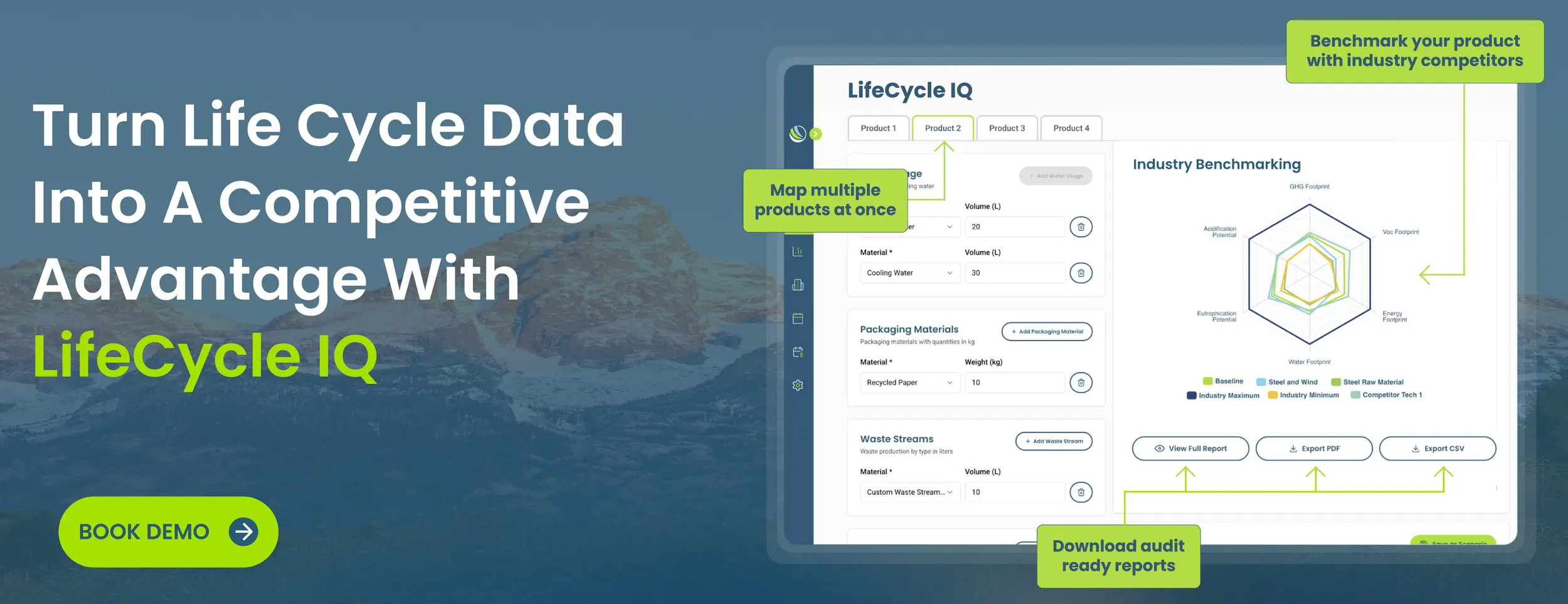
Book a short call to see how your products perform beyond carbon, from water use to particulate matter.


